Couples Creating Art Release Oxytocin but Men Who Paint Release the Most
Summary: A new written report reveals couples who create art or play board games together release oxytocin. Researchers written report males release 2 to 2.v times more oxytocin when creating art with their loved one.
Source: Baylor Academy.
When couples play board games together or accept a painting class with each other, their bodies release oxytocin — sometimes dubbed the "hugging hormone." Merely men wielding paintbrushes released twice every bit much or more than as the level of women painters and couples playing games, a Baylor University study has found.
"We were expecting the opposite — that couples playing the board games would interact more than considering they were communicating about the games and strategies, or because they were competing, and with more interaction, they would release more oxytocin," which is associated with bonding and family cohesiveness, said Karen Melton, Ph.D., assistant professor of child and family studies in Baylor'south Robbins Higher of Health and Homo Sciences.
The study — "Examining Couple Recreation and Oxytocin Via the Environmental of Family Experiences Framework" — is published in the Journal of Marriage and Family unit, the journal of the National Council on Family Relations.
Researchers also expected that painting couples would be more attentive to the instructor and to the canvas than to their partners — but instead, couples in the art class reported more than partner-touching than couples playing board games.
"Typically, an art class is non seen as an interactive date with your partner. Just sometimes couples that were painting turned the action into a bonding time by choosing to collaborate — putting an arm around their partner or simply saying, 'Expert chore,'" Melton said.
The report is the first to examine how singled-out types of leisure are associated with oxytocin release, researchers said.
"Our big finding was that all couples release oxytocin when playing together — and that'southward good news for couples' relationships," Melton said. "Simply men in the art class released 2 to ii.5 times more oxytocin than the other groups. This suggests that some types of activities may be more beneficial to males than females, and vice versa."
Of the four groups, the release of oxytocin increased most for the men in the fine art form, followed by women playing board games; women in the art form; and last, men playing board games. But the last three groups did not differ significantly from 1 some other, the study found.
Researchers besides identified a pregnant ecology bear on, in that couples in a novel setting and action released more oxytocin than in a familiar home-similar environment. That suggests that novelty can be an of import factor to consider when planning date nights with our partners.
For the study, Melton and Maria Boccia, Ph.D., professor of child and family studies, recruited twenty couples ranging in age from 25 to xl. Couples were randomly assigned to participate in ane of ii couple dates — game night or couple art form — for one hour. One grouping played board games in a familiar home-like setting. Couples were lonely. These couples chose familiar games that would non require them to read instructions. Among the games were cards, checkers, chess, puzzles, dominoes, Monopoly and discussion games.
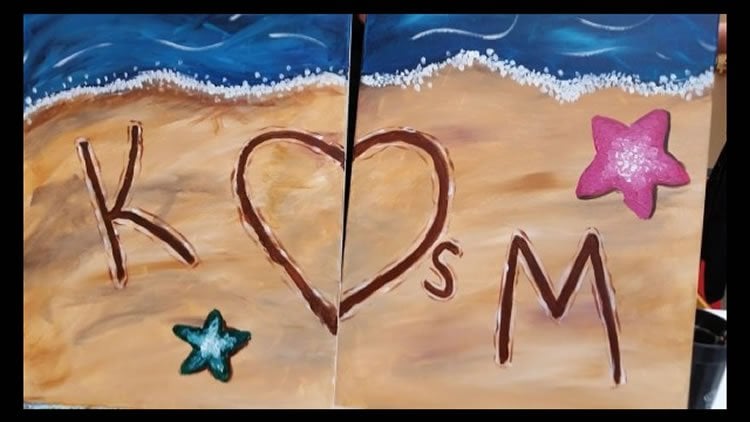
Meanwhile, the other group participated in painting classes for couples at a customs art studio. These couples participated in two groups of 5 couples. They painted a simple beach scene with their initials in the sand. The art instructor had prepared the canvases to reduce interactions betwixt the couples.
To mensurate participants' oxytocin levels, researchers took urine samples before and after the activities. They too administered a six-item survey virtually the couple's familiarity with the activities and about their communication, touch and center contact with their partners during the sessions, which lasted for about an hour.
In the future, Melton and Boccia want to explore further what role the environment may play in oxytocin release.
The researchers noted that their study differs from others, in which participants take been asked to perform specific deportment as cuddling, hand-belongings or massage, sometimes for an assigned period. The physical interactions in Melton and Boccia's report took place without prompting and lasted briefly.
"This has implications for the everyday family – to discover those small, meaningful ways to interact when they're eating dinner together or going for a walk or doing homework with a child or sitting on their couches with their iPad," Melton said.
"While, yes, this communication is simple, we also have to make sure we're doing the hard work … This is the hard advice: we have to make time for our families if we desire to accept families."
Nigh this neuroscience research article
Source: Terry Goodrich – Baylor University
Publisher: Organized by NeuroscienceNews.com.
Image Source: NeuroscienceNews.com prototype is credited to Karen Melton.
Original Research: Abstract for "Examining Couple Recreation and Oxytocin via the Ecology of Family unit Experiences Framework" past Karen 1000. Melton, Maddie Larson, and Maria L. Boccia in Journal of Marriage and Family. Published February 12 2019.
doi:ten.1111/jomf.12556
Cite This NeuroscienceNews.com Article
[cbtabs][cbtab title="MLA"]Baylor University"Couples Creating Art Release Oxytocin, But Men Who Paint Release the Most." NeuroscienceNews. NeuroscienceNews, 12 Feb 2019.
<https://neurosciencenews.com/couple-fine art-oxytocin-10726/>.[/cbtab][cbtab title="APA"]Baylor University(2019, February 12). Couples Creating Art Release Oxytocin, But Men Who Paint Release the Nearly. NeuroscienceNews. Retrieved February 12, 2022 from https://neurosciencenews.com/couple-art-oxytocin-10726/[/cbtab][cbtab title="Chicago"]Baylor Academy"Couples Creating Art Release Oxytocin, But Men Who Paint Release the Nearly." https://neurosciencenews.com/couple-fine art-oxytocin-10726/ (accessed February 12, 2019).[/cbtab][/cbtabs]
Abstruse

Examining Couple Recreation and Oxytocin via the Environmental of Family unit Experiences Framework
Objective:
To evaluate the release of oxytocin equally a biomarker of romantic‐partner attachment during couple recreation.
Background:
To appointment, no studies have examined the affect of singled-out types of recreation activities on the release of oxytocin. The Ecology for Family unit Feel framework, which highlights the divergent experience of family members, guided the experimental pattern.
Method:
A total of 20 cohabitating or married couples were randomly assigned to one of the following two experimental groups: board games or art class. Urinary oxytocin was measured before and subsequently the recreational activity. Analysis of covariance was used to make up one's mind grouping differences in oxytocin levels.
Results
All groups released oxytocin during couple activities. Men in the art grade demonstrated oxytocin response twice the level than other groups. Couples in the art class reported more partner touching than couples playing board games. A significant ecology impact was as well identified.
Decision:
Oxytocin is released during couple recreational activities. Some types of activities may contribute to college release of oxytocin than others. Key factors may include touch, novelty, and sex.
Implications:
Findings support the Ecology of Family unit Experience framework every bit a useful tool in examining factors of divergent and convergent couple experiences. Researchers should further explore the office of touch and surroundings in the release of oxytocin during couple activities.
Feel gratuitous to share this Neuroscience News.
Source: https://neurosciencenews.com/couple-art-oxytocin-10726/
0 Response to "Couples Creating Art Release Oxytocin but Men Who Paint Release the Most"
Post a Comment